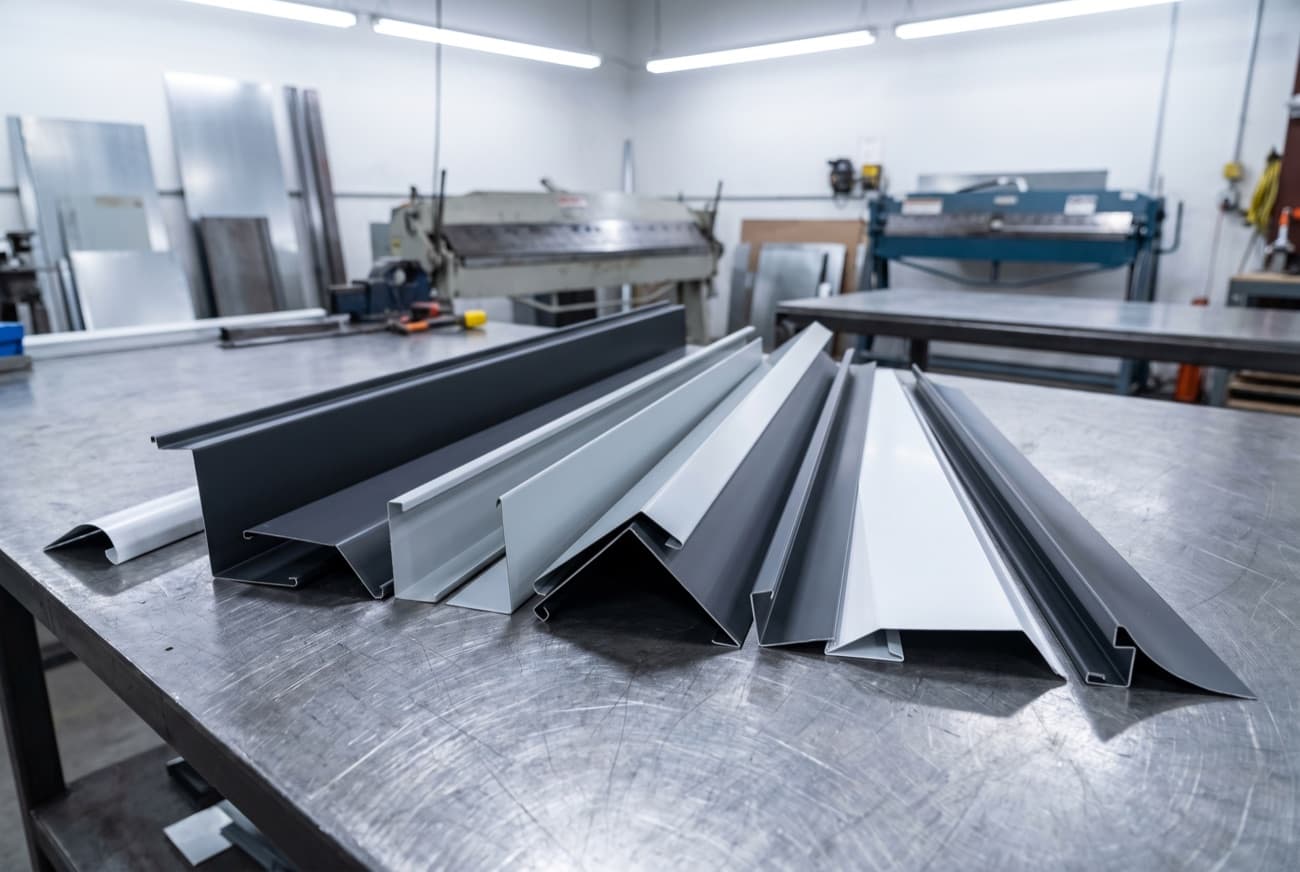
I get asked the kynar vs polyester metal finish question at least once a week, usually from a contractor holding two paint chips that look exactly the same. They are not the same. Not in the can, not on the coil, and definitely not after five winters facing Boundary Bay. One is a fluoropolymer built to survive UV like it owes it money. The other is a solid coating that does a perfectly good job for a while, then gives up in a very visible way.
This isn't a sales pitch for the expensive stuff. Sometimes polyester is the right call and I'll tell you when. But you need to know what you're buying before you spec a finish on a flashing job, because the failure mode shows up on the building, in daylight, in front of the homeowner.
What PVDF and SMP actually are
Kynar 500 and Hylar 5000 are brand names for PVDF resin — polyvinylidene fluoride. It's a fluoropolymer coating, baked onto the coil in a continuous process, typically at 70% resin content for the good stuff. The fluorine-carbon bond in that resin is chemically stubborn. UV radiation can't break it apart the way it breaks apart ordinary polymer chains. That's the whole story in one sentence, and it's why PVDF coatings have been the standard for architectural metal since the 1970s.
SMP stands for silicone-modified polyester. It's a polyester resin with some silicone blended in to improve UV resistance over a straight polyester. It's cheaper to produce, easier to run through some coil lines, and it looks identical to PVDF the day it's installed. The silicone modification buys it some UV life, but it's still a polyester backbone underneath, and polyester backbones degrade under sun exposure. That degradation is chalk. It's the resin breaking down at the surface and releasing pigment particles, which is why you can run a white glove across an old polyester-coated flashing and it comes back looking like you wiped a chalkboard eraser.
Straight polyester, no silicone modification at all, is the bottom tier. Fine for interior work, fine for stuff that's never going to see direct sun, and that's about it.
What "fade" and "chalk" ratings mean on a real wall in Surrey
Coating manufacturers rate their products against AAMA 2605 (the high-performance PVDF spec) or AAMA 2604 (the mid-range spec that most SMP products fall under). AAMA 2605 requires coatings to hold up under 10 years of South Florida exposure testing with limits on chalk (rated on a scale, typically requiring less than a #8 rating) and color change (measured in Delta E units, usually capped around 5 units after a decade).
South Florida testing sounds irrelevant to Delta or Surrey until you remember what it's actually simulating: intense, sustained UV exposure. We don't get Florida humidity here, but we get long summer days, high-altitude UV bouncing off water on the Fraser, and a lot of south and west-facing walls that bake all afternoon. A flashing over a south-facing entry canopy in Surrey or a west wall in White Rock is getting a real UV dose over a 20-year building life. PVDF rated to 2605 is built for exactly that. SMP under 2604 is rated for a shorter, less demanding curve, and the gap shows up as chalking that's visible from the sidewalk, not just under a microscope.
Here's what actually happens on site. I've pulled flashing samples off buildings in Tsawwassen and Ladner that were installed with mismatched coatings — PVDF panel, polyester flashing — and at the seven or eight year mark the flashing has gone dull and slightly powdery while the panel two inches away still has sheen. It's not subtle once it starts. Clients notice it before contractors do, usually right before they call about a warranty.
Match the flashing coating to the panel coating, always
This is the point most spec sheets skip and the point that actually saves callbacks. If the wall panel is a PVDF finish from a major coil coater, order the flashing in the same coating family, ideally the same paint line if the manufacturer supports it. A lot of the big producers publish matched flashing coil specifically so trim and panel age at the same rate and in the same direction.
Mixing coatings on the same elevation is asking for a two-tone building. Not on day one, on day one thousand. Same color number, different resin chemistry, different fade curve. Five years out you've got a graphite panel and a graphite flashing that no longer read as the same color, and there's no touch-up paint that fixes chalking cleanly. You end up replacing flashing on a building that otherwise has a decade of life left in the cladding. We deal with this all the time on custom colour matching requests, where someone's trying to match an existing PVDF wall system and the only sample they can find is an off-cut with no paint code on it.
If you're matching to existing siding rather than a spec sheet, that's a slightly different problem and worth reading up on separately — we cover the process in more detail in our piece on color-matching custom flashings to existing siding.
What the warranty actually covers, and who's on the hook
Read the warranty document, not the brochure. Coil coating warranties from the big producers (Sherwin-Williams, PPG, Valspar/AkzoNobel coatings, whoever your coil source runs) typically split into two separate promises: film integrity and color retention.
Film integrity covers things like cracking, peeling, and chipping — the coating physically failing off the substrate. This is usually warranted for 20 to 40 years on PVDF and it's a pretty low bar to hit, because a well-applied fluoropolymer rarely delaminates.
Color retention and chalk resistance are the parts that actually vary. On a strong PVDF product you'll see 20 to 30 year color and chalk warranties. On SMP, it's commonly 10 to 15 years, and sometimes shorter for lighter or darker colors that show fade more visibly (dark colors absorb more UV, so deep bronze or black tends to fade faster than mid-tone grays regardless of resin).
Here's the part nobody likes hearing: the warranty is issued by the coil coater or the panel manufacturer, and it typically travels with the original material, not with whoever fabricates the flashing. If we form a flashing from coil you supplied, the coating warranty is between you and your coil source, not us. We stand behind our forming work — fabrication defects, seam integrity, dimensional accuracy — but we didn't cook the paint, so we can't warrant fade. Make sure whoever specs the job understands that split before a colour dispute happens three years in.
Where polyester is genuinely the right choice
I don't push PVDF on every job, and any shop that does is either not thinking it through or padding the invoice.
- Soffit metal. It's shaded, it doesn't get direct UV, and chalk resistance barely matters when the sun never hits it. Polyester or SMP is fine here and it's a legitimate place to save money. See our notes on soffit and fascia trim for gauge and finish choices on shaded applications.
- Interior metal work. No UV exposure at all indoors. Paying for PVDF on an interior trim piece is money that should have gone somewhere else on the job.
- Short-life or temporary buildings. If the structure has a planned 10 to 15 year life, or it's a rental property being flipped in that window, SMP's lifespan matches the building's lifespan. No reason to over-spec.
- North-facing and heavily shaded elevations. A north wall under mature trees in Coquitlam gets a fraction of the UV dose of a south wall in Surrey. Polyester can genuinely hold up fine there, though I'd still match it to whatever's on the sunnier elevations for consistency.
The mistake is using polyester because it's cheaper on a south or west elevation and hoping nobody notices in a decade. Somebody always notices.
Price difference: what it actually costs in BC dollars
Coil pricing moves with aluminum and steel markets, but the spread between PVDF and SMP has stayed fairly consistent for years. Expect PVDF-coated coil to run roughly 15-25% more per sheet than SMP or polyester in the same gauge and substrate. On a standard 4x10 sheet of .032 aluminum, that can mean a difference of $15-30 per sheet depending on color and supplier.
Translated into finished flashing, we're usually looking at something like $1-2 extra per linear foot for PVDF over polyester on a typical custom profile, more if it's a premium metallic or dark color that runs a surcharge regardless of resin. On a full custom flashing package for a mid-size residential project — say 200 to 400 linear feet across kick-out, step, and parapet caps — that's often a few hundred dollars difference on the whole job. Against a 20-plus year fade warranty versus a 10-year one, it's not usually a close call for anything visible from the street.
Where it does get close is large commercial runs. At a few thousand linear feet, that per-foot spread adds up fast, and that's where the shading and lifespan questions above actually matter for the budget.
How to specify it on your quote request
Don't just write "match the siding." Give us something we can actually order against:
- Panel manufacturer and product line (e.g. "Vicwest, Colorbond finish" or the specific coil coater's paint code).
- Resin type — PVDF/Kynar 500, SMP, or straight polyester — not just a color name.
- The exact color code if you have it, or a physical sample chip if you don't. Digital photos of siding under different light are close to useless for matching resin sheen.
- Gauge and substrate (aluminum vs Galvalume vs steel), since finish and metal choice affect each other. If you're unsure which substrate suits the job, our breakdown of Galvalume vs aluminum vs stainless flashing material is a good starting point.
- Where each flashing profile goes on the building, so we can flag if you're putting polyester on a south wall by accident.
The more specific the request, the faster we can turn a quote and the less chance of a color mismatch showing up on a scaffold six weeks from now. If you want a broader rundown on how we build out a fabricator's quote line by line, our guide on reading a metal fabricator's quote walks through where finish codes show up and what they mean for pricing.
Every custom flashing order we run goes out with the coating type documented on the shop ticket precisely because of this issue — we've seen too many jobs where "match existing" turned into a dispute two years later because nobody wrote down which resin went on which elevation. If you're not sure what's on the building already, bring a sample or a photo with the panel manufacturer's tag if it's still attached, and we'll help you figure out the closest match before we cut anything.
If you've got a set of flashing details ready to go, or even just a rough sketch and a panel color code, send your sketch for a quote and we'll tell you same day what gauge, coating, and profile makes sense for where it's going on the building.
Frequently asked questions
Can I run polyester flashing against a PVDF wall panel?
Don't. Same colour number, different resin chemistry, different fade curve. Samples pulled off buildings in Tsawwassen and Ladner with PVDF panels and polyester flashing showed the flashing dull and powdery at the seven or eight year mark, while the panel two inches away still had sheen. No touch-up paint fixes chalking cleanly. Match the flashing to the panel's coating family.
Who covers the warranty if a finished flashing fades?
The coil coater or panel manufacturer. The coating warranty typically travels with the original material, not the fabricator. Strong PVDF products carry 20 to 30 year colour and chalk warranties, and SMP is commonly 10 to 15 years. If the shop forms flashing from coil you supplied, fade is between you and your coil source. The shop stands behind forming work only.
Where is polyester or SMP the right finish?
Wherever UV isn't the problem. Soffit metal is shaded, interior trim sees no sun, and a building with a planned 10 to 15 year life doesn't need a finish that outlasts it. North-facing and heavily shaded elevations can hold up fine too, though matching the sunnier walls keeps things consistent. Polyester on a south or west elevation is the mistake.
How much more does PVDF add to a custom flashing package?
Usually $1-2 extra per linear foot over polyester on a typical custom profile, more for premium metallics or dark colours. PVDF coil itself runs roughly 15-25% more per sheet. On a mid-size residential package of 200 to 400 linear feet, that's often a few hundred dollars across the whole job. Visible from the street? Rarely a close call.