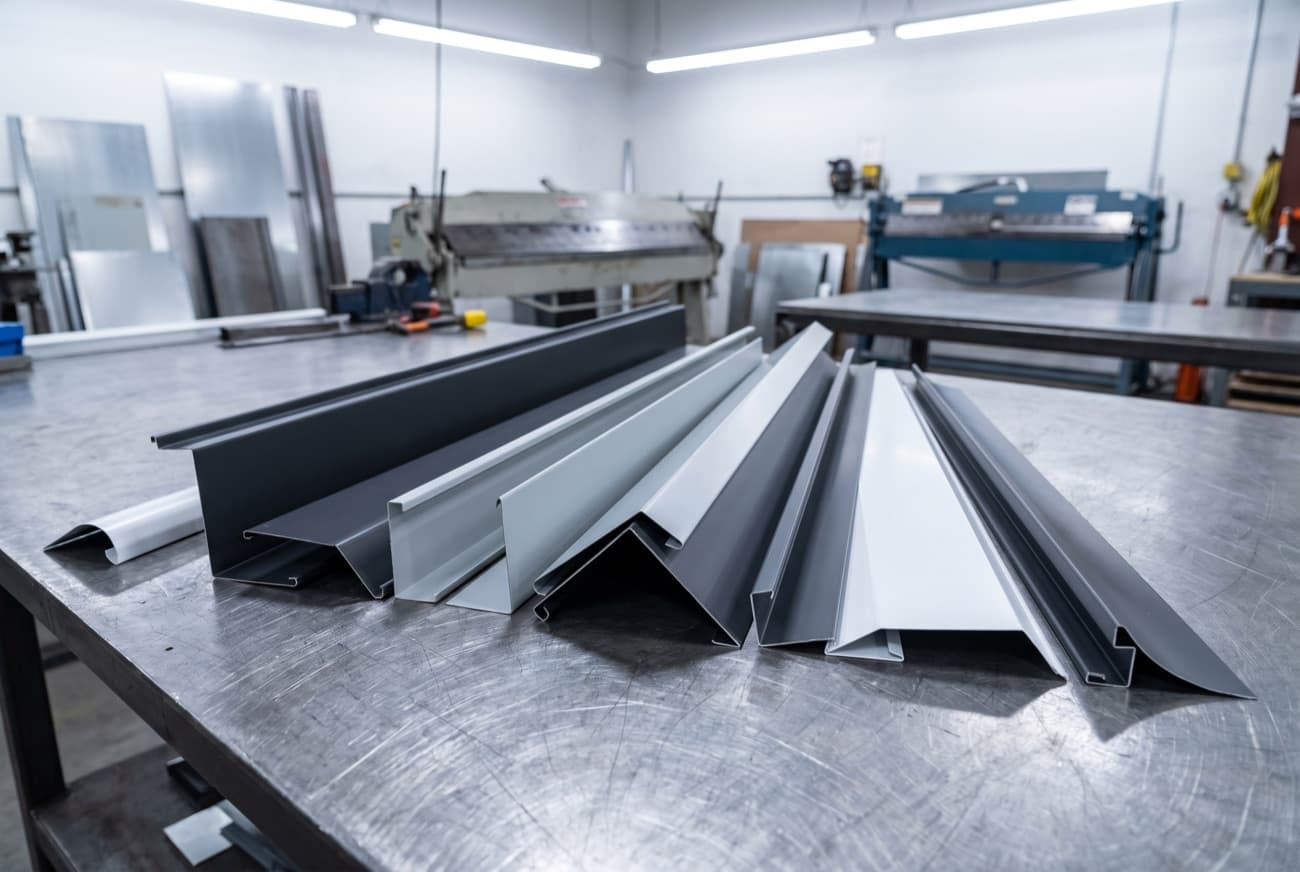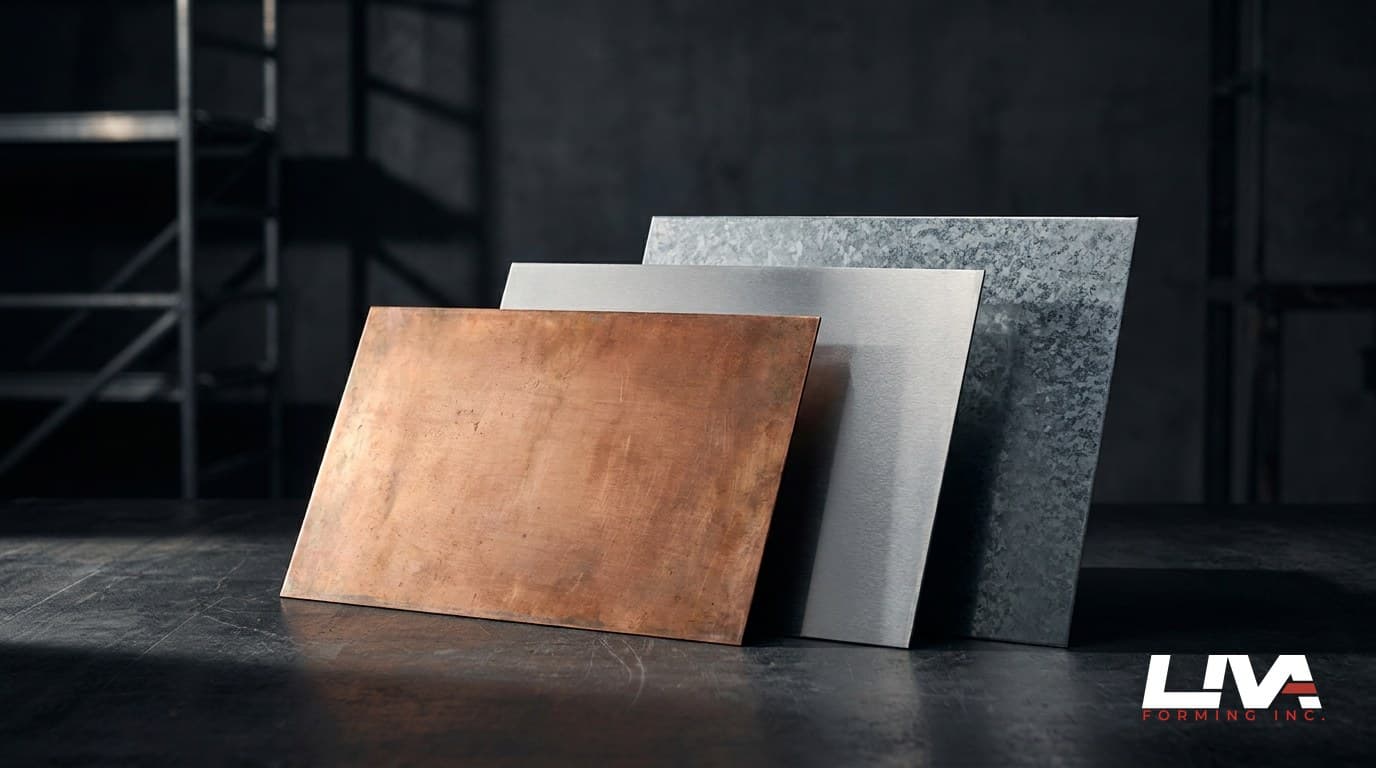
Most flashing failures on residential and light commercial buildings in BC don't come from bad install. They come from the wrong metal being used in the wrong climate. We see it constantly: a contractor used what their supplier had on the shelf, the building stood in coastal exposure for eight years, and now the flashings are bleeding rust streaks down the cladding.
This is a working guide for picking between the three metals that handle ninety-plus percent of residential and light commercial flashings work: galvanized steel, aluminum, and copper. Each has a place. None of them is universally best. The trick is matching the metal to where the building actually sits and how long the owner expects it to last. This one focuses on metal selection; for the wider workflow, see our guide to choosing flashings for siding.
The short version, for contractors who just want the answer
If you skip the rest of this article and only read one paragraph, here it is. For dry interior BC and shielded urban Lower Mainland work, galvanized 26-gauge is the default. It's cheap, it bends well, and it lasts twenty to thirty years in those conditions. For anything within ten kilometres of saltwater or on a heavily exposed site, switch to aluminum or coated aluminum. The upfront cost is twenty to thirty percent higher but the lifespan goes up two-to-three times. For premium architectural work where the flashing is meant to be visible and to last a century, copper is the choice: expensive, beautiful, and effectively permanent.
That paragraph will get you ninety percent of the way there. The rest of this article is the why behind it, and the edge cases where the default answer isn't quite right. For the metallurgy behind these choices, see our comparison of Galvalume vs aluminum vs stainless.
Galvanized steel: the default for a reason
Galvanized steel flashings are steel sheet coated with a thin layer of zinc. The zinc gives sacrificial corrosion protection. It oxidizes before the steel does, so as long as the coating is intact, the underlying steel stays sound.
What galvanized does well:
- Cost. Cheapest of the three by a meaningful margin. On a typical residential project the material cost difference between galvanized and aluminum is small in absolute dollars, but on commercial-volume work or multi-family it adds up fast.
- Stiffness. Steel is stiffer than aluminum at the same gauge. Long runs sag less, edges hold their bend better, and the metal feels solid in your hands. Crews used to working with it know what to expect.
- Bend behaviour. Holds folds cleanly, doesn't crack at tight radii (within reason), and seams cleanly. A fabricator can run aggressive bends without the metal complaining.
What galvanized doesn't do well:
- Salt exposure. This is the big one. Salt accelerates the corrosion of zinc, and once the zinc is consumed the steel underneath starts to go quickly. Within a few kilometres of saltwater, and especially on the windward side of buildings, galvanized flashings can show rust through within five to eight years. We've replaced flashings on West Vancouver and White Rock homes that were less than a decade old.
- Cut edges. Wherever the metal is cut, the zinc coating is gone. Those exposed edges rust first. On precision-cut custom flashings this matters less because the cuts are minimal; on field-cut installs with rough edges, it matters a lot.
- Acidic or industrial environments. Less common in residential BC, but worth flagging: areas downwind of industrial sources or with consistent acid rain see accelerated galvanized corrosion.
Where galvanized is the right call in BC: Most of Greater Vancouver away from immediate coastline, all of the Fraser Valley, the entire Interior, and most of the Okanagan. Anywhere the air is reasonably clean and salt isn't a daily factor.
Expected lifespan in those conditions: Twenty to thirty years for 26-gauge G90 galvanized. Heavier coatings (G185, for example) push it longer. Painted or pre-finished galvanized adds another barrier and another decade of typical life.
Aluminum: the right answer for marine and exposed sites
Aluminum flashings are formed from solid aluminum sheet. There's no coating to wear through because the metal corrodes uniformly and slowly across its whole thickness, and it forms its own oxide layer that protects what's underneath.
What aluminum does well:
- Saltwater performance. This is where aluminum earns its premium. The natural aluminum oxide layer self-heals when scratched, and it's not vulnerable to salt the way galvanized steel is. Coastal homes that need flashings to last forty years should be running aluminum.
- Weight. Significantly lighter than steel at the same gauge, which matters on long continuous runs and on detail work where weight affects how the flashing sits on framing.
- Painted and pre-finished options. Aluminum takes coatings well. Kynar-finished aluminum holds colour for thirty-plus years without significant fading and resists chalking far better than painted galvanized.
- No rust streaking. Even when aluminum eventually oxidizes, it doesn't bleed rust down the cladding the way failing galvanized does. The failure mode is graceful. The metal goes dull, not ugly.
What aluminum doesn't do well:
- Cost. Twenty to thirty percent more than galvanized for the same project, depending on gauge and finish.
- Stiffness at thin gauges. Aluminum is softer than steel, so at thinner gauges it dents more easily and oil-cans more on long flat runs. Most aluminum flashing work is one gauge heavier than the galvanized equivalent. For example, 24-gauge aluminum where you'd use 26-gauge galvanized.
- Galvanic corrosion with steel fasteners. If you fasten aluminum flashings with regular steel screws or nails, you can get galvanic corrosion at the fastener points. Use stainless or aluminum fasteners with aluminum flashings, full stop.
- Bend radius. Aluminum cracks at tighter radii than steel does, particularly at colder temperatures. Fabricators size bend radii accordingly; field bending aluminum flashings is harder than field bending galvanized.
Where aluminum is the right call in BC: Anywhere within roughly ten kilometres of saltwater (so most of the Lower Mainland coastline, all of Vancouver Island, the Sunshine Coast, the Gulf Islands, and the North Coast). Also any heavily exposed site regardless of location: mountaintops, ridge homes, lakeside properties with prevailing wind exposure.
Expected lifespan in those conditions: Fifty to seventy years for plain aluminum. Kynar-finished aluminum can run a century with proper detailing.
Copper: when the flashing is part of the architecture
Copper is the premium choice: visually striking, effectively permanent, and expensive enough that it tends to be specified rather than chosen by default.
What copper does well:
- Lifespan. Copper flashings on European cathedrals have been in service for hundreds of years. Realistically, on a modern building, you're looking at the flashings outlasting the structure they're attached to.
- Patina. Copper develops a green-brown patina over time that protects it from further corrosion. Many architects spec copper specifically because the patina is the design intent. It's a flashing that gets better-looking with age.
- Self-healing. Like aluminum, copper's oxide layer protects what's underneath. Unlike aluminum, copper's protective patina is the visual finish, not something to be hidden.
- Workability. Copper is soft and forms beautifully. Detailed profiles, complex curves, and tight radii all work with copper better than with steel. Hand-formed restoration work almost always uses copper for this reason.
What copper doesn't do well:
- Cost. Three to five times the price of galvanized for the same project. On a residential job this adds thousands of dollars; on commercial, tens of thousands. Most projects can't justify the spend.
- Theft risk. Copper is valuable as scrap. On unoccupied sites, on slow-build projects, or in some urban locations, exposed copper flashings get stolen. We've seen copper drip edges pulled off houses during framing.
- Staining. Copper runoff stains adjacent materials. Copper flashings above unpainted concrete, stone, or light-coloured cladding will leave green streaks within a year or two. Designers handle this with planned drainage paths; uninformed installations cause callbacks.
- Galvanic compatibility. Copper is far from steel and aluminum on the galvanic series. Don't mount copper flashings with steel fasteners (the steel corrodes), and don't run copper drainage onto aluminum surfaces (the aluminum corrodes). Stainless steel fasteners and isolated detailing are non-negotiable.
Where copper is the right call in BC: Premium custom homes where the architect has spec'd it, historical restoration where the original material was copper, churches and heritage buildings, and any project where the flashings are intended as visible architectural detail rather than utilitarian water management.
Expected lifespan: Effectively unlimited. Copper flashings outlive the buildings they're on, the contractors who installed them, and usually the contractors who installed them after that.
Cost comparison in real numbers
Pricing changes constantly, but the ratios stay roughly consistent. For a typical residential project (say, ten lineal metres of custom head flashings for windows), here's the rough material-cost ratio:
- Galvanized 26-gauge: baseline cost. Call it $1.
- Pre-finished galvanized (Kynar painted): $1.30 to $1.50.
- Aluminum 24-gauge plain: $1.25 to $1.50.
- Kynar-finished aluminum: $1.60 to $2.00.
- Copper 16-ounce: $4.00 to $6.00.
Labour cost to install is roughly the same across materials, with slight increases for copper because of fastener handling and detail care. So the all-in project cost difference is less dramatic than the material cost difference. Typically aluminum is ten to twenty percent more expensive than galvanized once labour is included, and copper is two to three times the total.
The decision frame that actually matters: cost per year of expected service life. By that measure, aluminum on a coastal site is cheaper than galvanized, because you're amortizing over forty years instead of replacing in ten. Galvanized in the Interior is cheaper than aluminum, because the lifespan gap closes when the salt isn't there. Copper is almost never the cheapest by this measure unless the alternative is replacing a flashing every fifteen years for a century.
Coastal versus interior: a fast decision frame
If you're not sure which side of the salt-exposure line a project sits on, here's the rule we use:
- Strict coastal (within five kilometres of saltwater, exposed to prevailing wind): Aluminum minimum. Consider copper for premium work. Galvanized is a false economy here.
- Near-coastal (five to fifteen kilometres of saltwater, or sheltered coastal): Aluminum is the safe call. Galvanized works but expect shorter life. Figure fifteen to twenty years instead of twenty-five to thirty.
- Lower Mainland inland (Surrey, Langley, Burnaby east, Coquitlam): Galvanized is fine. The salt influence drops off quickly once you're behind the first ridge of hills.
- Interior BC (Okanagan, Kamloops, Cariboo, Kootenays): Galvanized is the standard, and 26-gauge G90 lasts well over thirty years in dry interior conditions. Aluminum is overkill for cost.
- Northern BC and remote coastal: Aluminum for coastal exposure, galvanized inland. Lead time and freight cost often matter more than the material choice. Work with a fabricator who can ship reliably.
Mixing materials on one building (don't, mostly)
Galvanic corrosion is the issue. When two different metals are in electrical contact and there's moisture between them, the more reactive metal corrodes faster. The further apart on the galvanic series, the worse the reaction.
Practical implications:
- Don't fasten aluminum flashings with regular steel screws. Use stainless or aluminum fasteners.
- Don't fasten copper flashings with steel screws. Use copper or stainless. Some copper installations use bronze nails as standard.
- Don't run runoff from copper onto aluminum or galvanized surfaces. The downstream metal corrodes.
- Don't mount aluminum flashings on copper-rich pressure-treated lumber. Modern ACQ-treated lumber is mildly corrosive to bare aluminum. Use a separator (housewrap, peel-and-stick) between aluminum and treated wood.
The cleanest jobs use one metal across the whole flashing package on a project. Mixing creates failure modes that show up years later and are hard to diagnose when they do.
The decisions that actually matter on every project
When a contractor calls us asking which material to spec, our questions are almost always the same. Run yourself through them on your next project:
- How far from saltwater is the building? Under five kilometres → aluminum. Over fifteen kilometres → galvanized is fine.
- How exposed is the site? Wind-blasted ridge or coastline → step up to aluminum even inland. Sheltered urban lot → galvanized works.
- What's the expected building lifespan? Premium custom home expected to last a hundred years → consider copper or Kynar aluminum. Standard residential → galvanized or aluminum is appropriate.
- What's the architect or owner's tolerance for visible aging? Galvanized darkens and eventually streaks. Aluminum stays uniform. Copper patinates green. Choose the aging story they want.
- What's the budget headroom? If the project can't absorb a twenty percent flashings premium, galvanized is the answer for any non-coastal site.
Five questions, two minutes, and you've got the right material call on most projects.
Working a project that needs custom flashings in a tricky material? We run galvanized, aluminum, prefinished, and copper. Send your sketch and the project location, and we'll come back with material recommendations and a quote the same day.
Send your spec for a quote and we'll come back the same day.
FAQ
Can I use aluminum flashings with steel fasteners? Not if you want them to last. Steel fasteners in aluminum flashings cause galvanic corrosion at every fastener point. Use stainless steel or aluminum fasteners with aluminum flashings.
Is pre-finished galvanized a good middle ground between galvanized and aluminum? For mildly exposed sites, yes. Kynar-coated galvanized adds twenty to forty years to the base galvanized life, costs about half the premium of aluminum, and looks better long-term. For strict coastal exposure, it's still not as good as plain aluminum.
How long does galvanized actually last in coastal BC? Depends on exposure. Sheltered urban Vancouver: twenty years easily. White Rock or West Vancouver with direct ocean wind: eight to twelve years before visible rust. Salt exposure is the main variable, and it's not linear.
Does copper really require special detailing for runoff? Yes. Copper runoff stains stone, concrete, and most light-coloured cladding within a year or two. Architects handle this with planned drainage to gutters and away from visible surfaces. If you can't control where copper rainwater goes, don't spec copper above visible finishes.
Can you match a specific colour in aluminum? Within the standard Kynar palette, yes, and we can sample-match most factory-painted siding colours. For exact matches outside the standard palette, lead time goes up because the coil has to be custom-finished.