Most quotes sit in limbo because the shop has to email you three times asking for gauge, leg length, or what finish you actually want. We've run the same job in .032" aluminum for one contractor and .040" for another on the same building because nobody wrote it down. If you know how to order custom metal fabrication the right way, with complete specs up front, you get a quote back in two hours instead of two days.
Here's what needs to be in your request.
The Five Things Every Quote Needs
- Material and gauge. Not "aluminum trim": .032" or .040" aluminum, 3003-H14 or 5052-H32 if you care about coastal exposure. For steel, 26-gauge or 24-gauge galvanized. We default to .032" aluminum and 26-gauge galvanized if you don't specify, but that might not match what's already on site.
- Finish. Mill finish aluminum looks different every time depending on the coil run. If you want consistency across multiple orders, spec a painted finish. We use Kynar 500 or polyester depending on budget. For galvanized, tell us if it's getting job-site primer or staying bare. We've had contractors reject finished pieces because they expected bare steel and we sent primed.
- Bend angles and leg lengths. This is where most requests fall apart. "4-inch J-channel" tells us nothing. We need: 1" face, 90° back leg at 3", hemmed return. Every dimension. If you're matching existing trim, send a profile photo with a tape measure in frame or bring a sample piece to the shop. We keep templates on file for repeat clients but new profiles need exact measurements.
- Quantity. Unit pricing breaks at 50 linear feet, again at 200 feet. A 20-foot run costs more per foot than a 100-foot run because setup time gets amortized differently. If you're ordering samples to test fit, say so. We'll quote sample pricing and production pricing separately.
- Length per piece. Ten 10-foot sticks ship differently than one 100-foot coil. Our brake handles up to 12 feet in one pass; anything longer gets seamed or you take it in sections. Transportation matters too. A 20-foot box truck can't carry 12-foot lengths without diagonal loading, and some guys don't want to deal with that on site.
File Formats That Actually Work
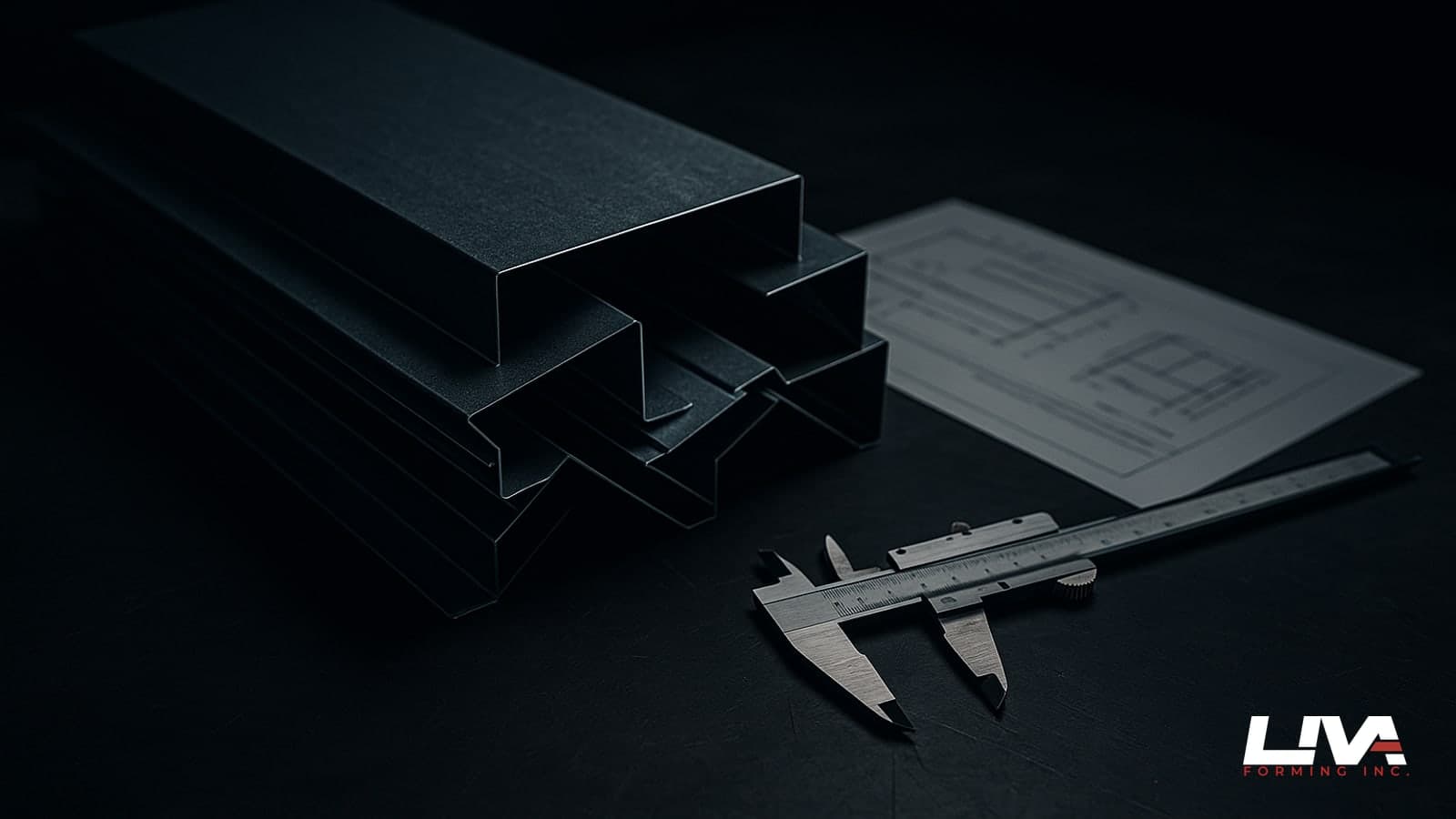
PDF or JPG of a dimensioned sketch works fine. Hand-drawn on graph paper is completely acceptable if the numbers are legible and you label every measurement. We don't need AutoCAD for a rake trim or a chimney cap.
If you do send CAD, export to DXF or PDF. Our system reads DXF directly for CNC programming but we're not opening .dwg files in 15 different AutoCAD versions to check layers and line weights. Flatten it, dimension it, send it.
SketchUp exports cause problems. The 3D model looks great but dimensional accuracy depends on how you set up your workspace and what units you exported. Always include a separate dimensioned elevation view (front, side, and section) with call-outs for material thickness and bend radii.
Photos work for matching existing profiles but only if you include a scale reference. A tape measure next to the piece, not a quarter or a pen. We've been off by half an inch because someone held their phone at an angle and the perspective made a 3" leg look like 3.5".
Common Mistakes That Add Two Days
- No inside or outside radius specified. When you call for a 90° bend, we default to our tooling, usually 1/8" inside radius for aluminum under .040". If you need tight radius for a specific fit or you're wrapping another flashing, say so. We've scrapped entire runs because a contractor assumed we'd match their previous supplier's tooling and we didn't.
- Forgetting about hem direction. A hemmed edge can fold up or down. It changes how the piece nests into adjacent trim and whether you can slide it onto a cleat. Specify "hem up" or "hem down" relative to the face of the piece, or mark it on your drawing with an arrow.
- Unclear about fastener locations. If you're nailing through the face, tell us. We'll add extra material width so you're not fastening 1/4" from a hem. If it's a concealed clip system, we need to know leg width and clip spacing before we start forming. Retrofit work is worse because you're matching existing hole patterns and we can't guess those.
- Not mentioning site conditions. Coastal install 200 meters from saltwater? We're recommending stainless fasteners and discussing whether .040" 5052 is worth the upcharge over 3003. High snow load on a valley flashing? Gauge matters. Wind-driven rain on a head flashing? We're checking slope and drip edge details. This isn't upselling. It's knowing what fails and what doesn't after watching the same profiles come back bent or corroded.
- Single-line drawings without thickness. You draw a profile as a centerline, we have to guess which side of the material the line represents. A 3" leg measured to the outside face is different than 3" measured to the inside of the bend when you're working in 26-gauge steel. Mark "outside dimensions" or "inside dimensions" at the top of your drawing.
What Speeds Up a Quote
- Reference a previous order if this is similar to something we've made for you before. "Same as job #4420 but in .040 instead of .032" gets you a quote in 30 minutes because we're pulling an existing file and adjusting material callouts.
- Send one consolidated request instead of four separate emails over two days. If you're pricing out three different flashing profiles for the same building, put them in one message with quantities for each. We'll quote them together and flag any details that need clarification across all three.
- Call if your timeline is tight. Email works for standard turnaround but if you need formed pieces on site by Thursday and it's already Monday, a five-minute phone conversation is faster than three rounds of email tag. We'll walk through the specs, confirm what's possible, and get the quote back while you're still on the phone if it's straightforward.
- Include a site address or project name. Not for quoting, but for file organization when you reorder six months later. "The Coquitlam townhouse job, blue siding" is easier to search than "custom zee flashing order from March." We've got 400+ active clients. A project reference saves time on both ends.
Material Lead Times Right Now
.032" mill finish aluminum and 26-gauge galvanized are in stock most weeks. Standard Kynar colors (white, black, bronze, grey) usually 3–5 business days if we don't have the exact color on the rack. Custom colors or specialty gauges like .050" aluminum can push two weeks depending on coil supplier inventory.
Stainless runs longer. 304 stainless in .025" or .031" typically takes 7–10 days unless we're already running another stainless job that week. 316 marine-grade stainless is special-order unless you're doing a large run. We don't stock it because demand is inconsistent.
Copper is live-market pricing. We quote it day-of and hold the price for 48 hours. If you approve three days later, we re-quote based on current copper pricing. 16 oz and 20 oz copper are standard weights; anything thinner or thicker is special-order through our metal supplier in Burnaby.
Why Some Details Matter More Than You Think
- Expansion and contraction. A 20-foot length of aluminum moves 1/4" over a 50°C temperature swing. If you're locking both ends into fixed J-channel with no slip joint, it's going to buckle in July or pull out in January. We'll ask about installation method (concealed fastener, face-nail, cleat system) because it affects whether we add slotted holes or recommend shorter lengths with seamed joints.
- Grain direction. When we're cutting from coil, the grain runs parallel to the coil length. If you're bending perpendicular to grain on a tight radius, the material can crack, especially in .040" aluminum or heavier. For complex profiles with multiple bends in different directions, we sometimes rotate the blank to keep critical bends parallel to grain. This only matters if you didn't specify and we have to guess which bend is load-bearing.
- Nesting and packaging. 100 pieces of 10-foot zee trim get bundled differently than 10 pieces of 100-foot coil. If you're doing a phased install and need 30 pieces this week and 70 pieces next month, say so. We'll package them separately instead of banding everything together. Job-site storage matters because not everyone has a covered area for 200 linear feet of primed steel sitting in the rain.
The One-Hour Quote Standard
If your request has material, gauge, finish, dimensions, and quantity, we're usually back to you in 60–90 minutes during business hours. Complex profiles with multiple bends or custom tooling requirements might take half a day because we're programming the brake and checking feasibility. Requests that come in missing two of the five core specs sit in the queue until we hear back from you.
Standard flashing profiles we've run before (head flashing, kickout flashing, rake trim, J-channel) are often same-day turnaround even if you're tweaking dimensions slightly. Completely custom profiles or first-time shapes take longer because we're validating that the design is actually formable without splitting material or creating spring-back issues that affect fit.
When to Send a Sample Instead
- Retrofit or restoration work where you're matching 40-year-old trim that's no longer available. Bring the piece in or mail it. We'll measure it, trace the profile, and shoot you a photo of the CAD drawing before we quote. This avoids the "it's close but not quite" problem when you're trying to describe a profile over email.
- Complex curves or non-standard angles. If the flashing has a 110° bend or a radiused corner, a sample or a full-scale template is more accurate than trying to dimension it on paper. We've had architects send us foam-core mockups for curved fascia trim. That works fine because we can transfer the profile directly.
- Layered assemblies where one flashing tucks behind another. Sometimes the only way to confirm clearance and overlap is to see how the existing pieces go together. A sample of both parts shows us the interlock detail and whether we need to adjust leg lengths or add a kickout.
What Happens After You Approve the Quote
We pull material and program the brake. Standard profiles run same-day or next-day depending on queue. Custom tooling or first-run profiles might take two days because we're setting up stops and checking the first piece for dimensional accuracy before running the full batch.
You get a call or email when it's ready for pickup, or we coordinate delivery if you're outside the Lower Mainland. Most orders go out within 3–5 business days unless material is on backorder or you've requested a specific delivery date.
Changes after approval restart the clock. If you call mid-production and change gauge or leg length, we're either scrapping what's already formed or finishing the partial run and starting a new batch. Last-minute changes cost more because material is wasted and setup time doubles.
Need a quote today? Send us the five core specs (material, gauge, finish, dimensions, quantity) and you'll have pricing back before lunch. Send your drawing for a quote or call if it's faster to talk through the details on the phone.
Frequently asked questions
What specs does a custom metal quote need?
Five things. Material and gauge, finish, bend angles with leg lengths, quantity, and length per piece. Write real numbers: .032" or .040" aluminum, 26-gauge or 24-gauge galvanized, every leg dimension and hem. With material, gauge, finish, dimensions and quantity in hand, the shop is usually back to you in 60 to 90 minutes during business hours. Requests missing two core specs wait in the queue.
What file formats work for flashing drawings?
A PDF or JPG of a dimensioned sketch is fine, and hand-drawn on graph paper works if every measurement is labeled and legible. Send CAD as DXF or PDF. Flattened, dimensioned, no .dwg files. SketchUp models need a separate dimensioned elevation with front, side and section views, plus material thickness and bend radii. Photos only work with a tape measure in frame.
Which drawing mistakes slow a quote down?
Five come up constantly. No inside or outside radius, no hem direction, unclear fastener locations, no mention of site conditions, and single-line drawings that never say whether legs are outside or inside dimensions. Each can add two days. Mark "hem up" or "hem down" on the drawing. Without a radius callout the shop defaults to its own tooling, usually 1/8" inside radius for aluminum under .040".
What happens if I change the order after approving the quote?
The clock restarts. Change gauge or leg length mid-production and the shop either scraps what's already formed or finishes the partial run and starts a new batch. That costs more, since material is wasted and setup time doubles. Standard profiles normally run same-day or next-day after approval, and most orders go out within 3 to 5 business days.