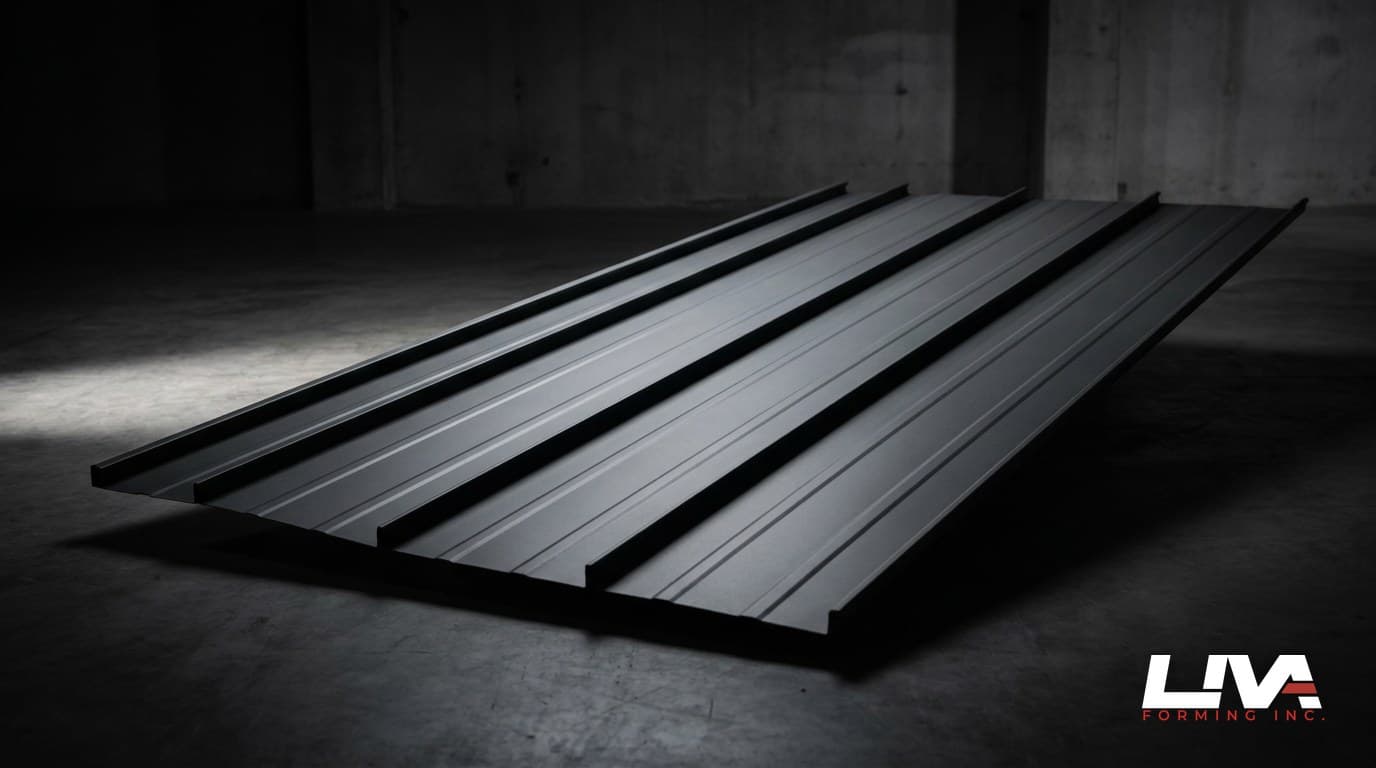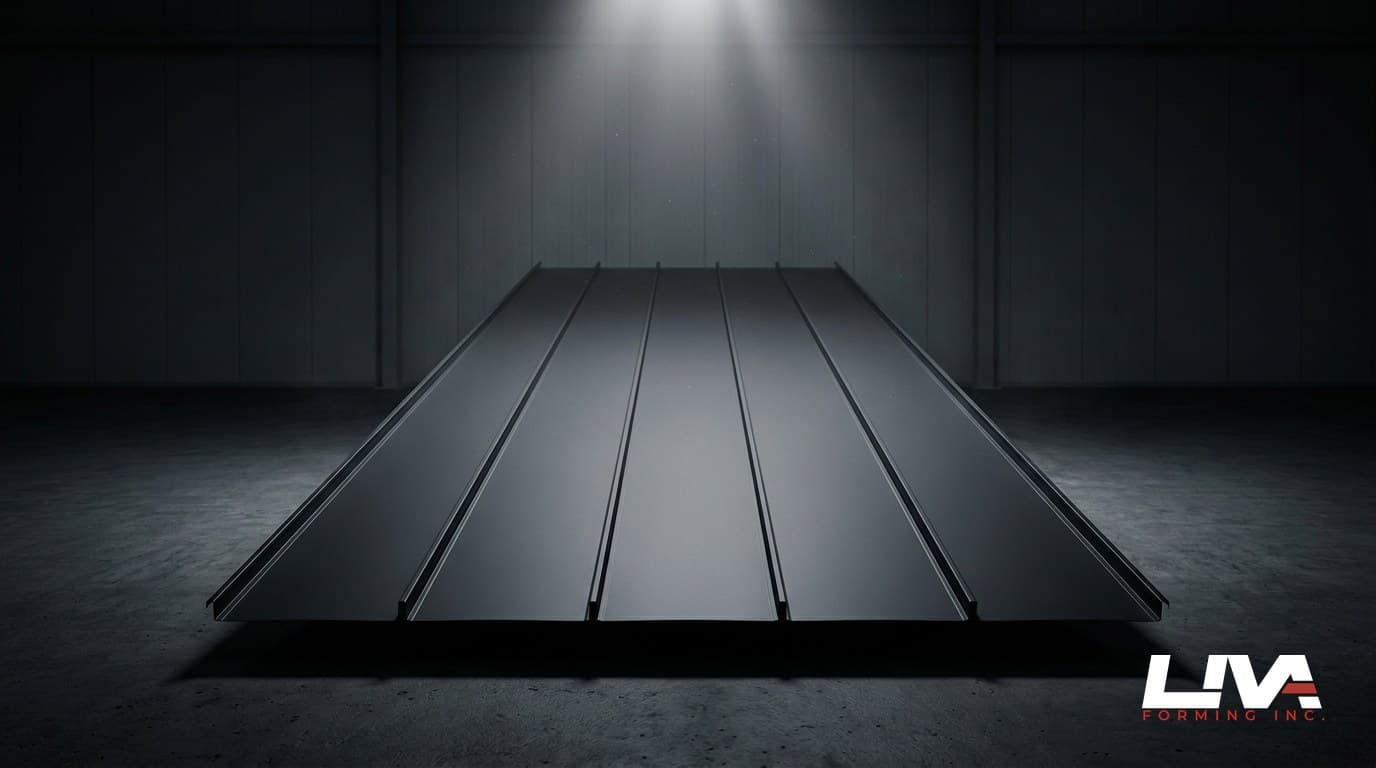
The first call usually goes like this. A North Vancouver builder is finishing a contemporary home with a long, low-slope shed roof. The architect drew a 16-inch wide panel at a 1.5-inch rib height. Every supplier the contractor has tried stocks 16-inch panels at 1-inch or 1.75-inch rib, not 1.5-inch. The architect won't budge on the shadow line. The builder is three weeks into specifying a roof that's holding up the trim and siding subs.
That's where custom standing seam panels enter the conversation. Not as an upgrade, not as a luxury option, but as the only way a specific elevation actually gets built. After 20 years running coil through brakes and roll formers in the Lower Mainland, the pattern is the same on every job: a stock profile gets specified first, the install math doesn't work, and someone calls a shop with the right tooling.
This piece is the practitioner version of when that call is worth making. What custom standing seam actually means in a forming shop, where the break-even sits in linear feet, what tolerance the panels can hold, where finish quality changes between roll-formed and press-brake panels, and the three BC project types where stock loses every time.
What "custom" means on a standing seam panel
The word covers four different things, and the price and lead time change for each.
Custom width. Most stock standing seam comes in 12", 16", 18", or 24" cover widths. A custom width is anything in between, and it shows up most often on heritage matches and architect-driven projects where the elevation rhythm was set by the original drawings. A shop with a slittable coil line can run almost any width inside the coil master's capacity, usually 12" to 24" finished cover.
Custom rib height. Standard ribs are 1", 1.5", 1.75", and 2". A custom rib is a less common dimension or a different profile geometry (tapered shoulders, square shoulders, double break at the seam). This is the one that triggers actual tooling work.
Custom length. Stock truckable panels stop around 40 to 45 feet because of trailer length. Continuous lengths past 50 feet need on-site forming, which a portable roll former can do at the job site. We've run 78-foot continuous panels for a commercial reroof in Port Coquitlam this way, single piece from eave to ridge, no end laps.
Custom finish or color. Anything outside the major coil houses' standard color cards. Pacific Northwest jobs often want specific Cascadia tones, RAL matches for architect color schedules, or PVDF finishes in colors that polyester libraries don't carry.
Most jobs we run as "custom" are actually a combination of width and length, with stock rib and stock color. The rib geometry custom is the rare and expensive one.
The break-even on rib geometry
Here's the question contractors ask most: at what LF does a custom rib profile pay off vs sourcing a close-fit stock panel and absorbing the design compromise.
For width-only changes, there's no break-even. Slitting a 16.5" cover instead of 16" costs the same as standard once the coil is on the line. The run starts in minutes.
For a true custom rib that needs new roller tooling, the math is different. A new tooling set on a portable or shop roll former runs about $4,500 to $12,000 in 2026 BC pricing, depending on shoulder geometry and how many station rollers it touches. Amortized across a single job, that means a one-time architectural project of 2,000 LF or more starts to justify the tooling on its own. Below that, the per-LF math doesn't pencil out unless the contractor expects repeat work in the same profile.
The shortcut most shops use: keep three or four rib geometries in active tooling, and quote the custom rib only when the spec actually won't accept any of them. On heritage matches where the original profile is gone, a one-time bend program on a press brake (not a roll former) lets us hit 100 to 800 LF without tooling cost, accepting that the panels are then limited to 10 or 12 foot lengths.
That's the working break-even in BC, mid-2026: under 800 LF, press-brake panels in 10-foot sections. 800 to 2,000 LF, source the closest stock profile or run press brake. Over 2,000 LF on a single rib profile, custom tooling on a roll former becomes the right call.
Tolerance reality
Drawings call for a 16-inch cover at 1.500 inches rib height. What you actually get depends on the equipment and the coil.
On a roll former with set tooling, cover width holds to about plus or minus 1/16 inch across the run. Rib height holds to about plus or minus 1/32 inch in the same coil. Across two different coils from different mill runs, you can pick up an extra 1/32 inch on rib geometry from springback variation.
On a press brake forming the same panel by hand-stop, you get tighter rib geometry per panel (the operator dials each break) but more variation between panels. Cover width is exact because it's gauge-set. Rib height holds about plus or minus 0.020 inch panel to panel.
The practical consequence shows up on visible architectural runs. If the panels are visible from 6 feet away on a wall application or a porch ceiling, those tolerances are inside what the eye sees as straight. On a long roof viewed from the ground, even 1/8 inch cover variation disappears. On a heritage match where the original panels were installed with hand-bent locks, the modern panel often looks too perfect.
That last point is real on Mount Pleasant rebuilds. We've had architects ask us to add subtle hand-formed variations to new panels so they read against original 1920s metal work without screaming "replacement."
Finish quality: roll-formed vs press-brake panels
Press-brake panels and roll-formed panels look the same on day one. They diverge over time, and the divergence is in the seam, not the field.
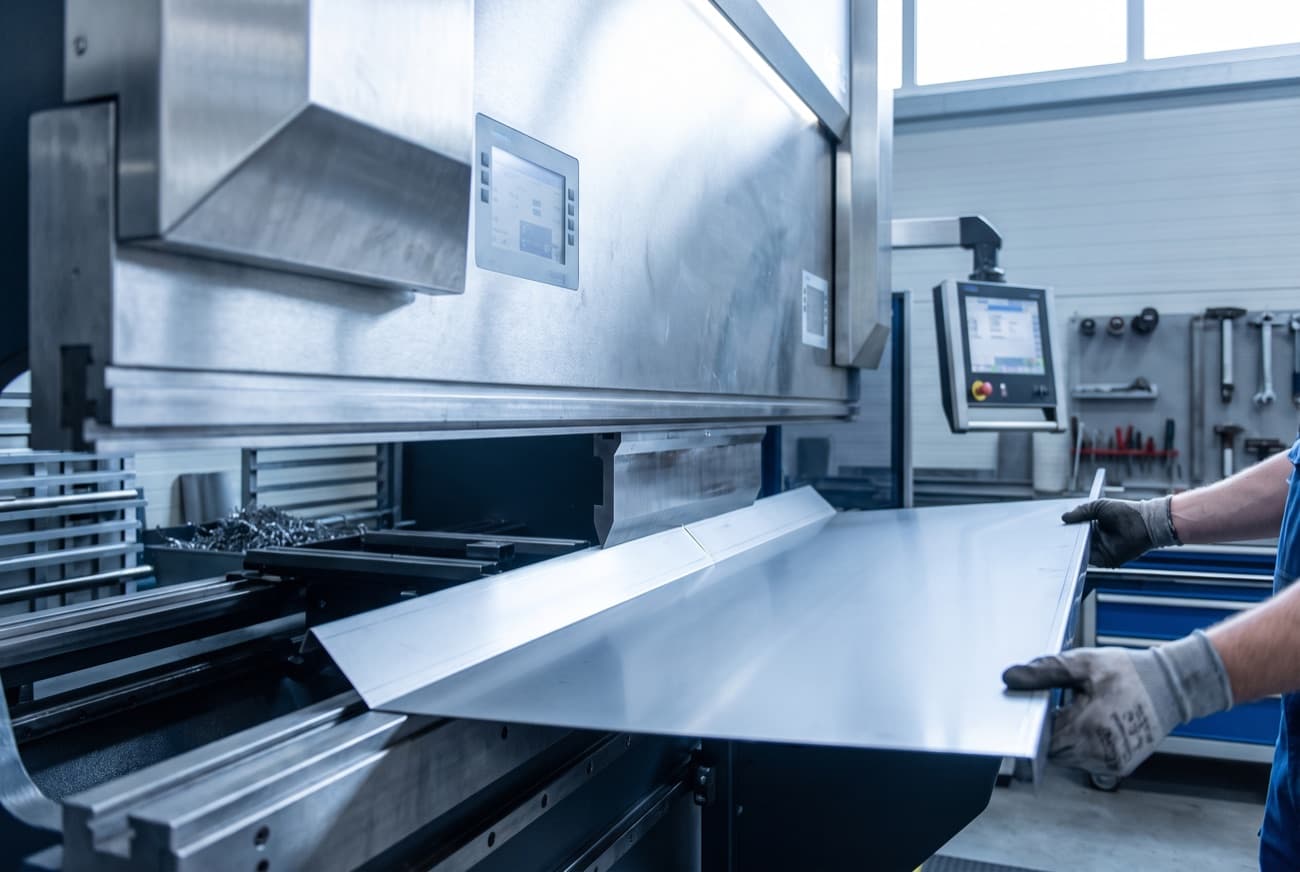
Roll-formed panels come off the line with a continuous, work-hardened rib. The metal at the rib base has been deformed slowly through five to eight roller stations, which leaves the coating intact and the geometry consistent. Snap-lock or mechanical lock seams engage cleanly because every rib is identical.
Press-brake panels have sharper break radii at the rib. The coating still survives if the brake has the right radius tooling and the operator runs the right speed, but the break is more aggressive than a roll former's gradual form. On polyester finishes, this matters less. On PVDF on a tight bend radius, you start to see crazing at the rib edge under UV after a few seasons, especially on south elevations getting the most exposure.
For shop work, the rule is straightforward: roll-formed for jobs over a few hundred LF or any job with PVDF finish at tight rib geometry, press-brake for short runs, heritage matches, and any panel under 10 feet long where the operator's dial-in is faster than threading a coil through a roll former.
Three BC project types where custom wins
Heritage match, Mount Pleasant
A 1928 house reroof needed panels that matched a neighboring building still wearing its original 1.25-inch rib at a 13-inch cover. No supplier carries that. The closest stock profile was 12-inch cover at 1-inch rib, which reads obviously wrong from the street. We ran 420 LF on the press brake in 18 separate panels, hand pre-formed locks, and the heritage consultant signed off on the visual match. The custom premium over stock was about $1,800 on a job that would have been re-roofed twice if the wrong panel went up.
Architectural commercial, Port Coquitlam
A 14,000 sf single-slope commercial reroof on a long, narrow building. The architect specified 18-inch cover panels in a continuous length from eave to ridge, 62 feet per panel. No stock truck-delivered panel handles 62 feet. We mobilized a portable roll former to the site, ran 28 panels in two days, and the GC saved 9 days off the install schedule because there were zero end laps to flash. Tooling cost was zero because the standard rib was already in our roller. The custom part was the length.
Modern North Van rebuild
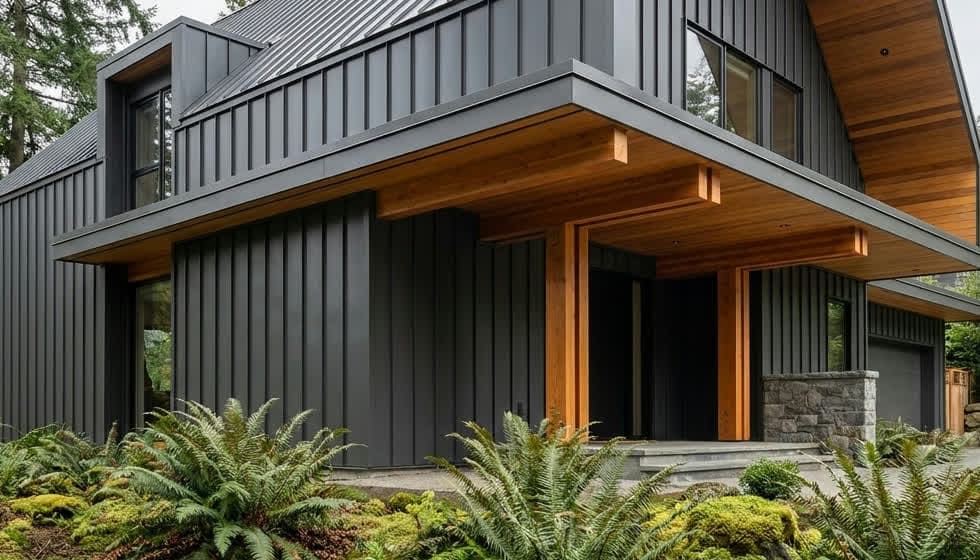
A contemporary 4,800 sf rebuild specified a 1.5-inch rib at 16-inch cover in 22ga prefinished aluminum, PVDF Cascadia Charcoal Slate. The 1.5-inch rib was the design driver because the architect wanted a specific shadow line. We had the rib in tooling from a prior commercial job, so the per-LF cost came down to coil and labor. Total panel area was 3,100 sf, lead time was 12 business days from drawing approval to delivery.
In all three, the contractor saved real time and real money by going custom from the start instead of trying to make a stock profile fit the architect's elevation.
What to send to get a real quote
For custom standing seam, the RFQ has to carry more information than a flashing job. The shop is committing to either coil orders or tooling work, and back-and-forth burns days.
A useful RFQ has all of this:
- Cover width (e.g., 16 inches exact, not "about 16")
- Rib height and rib geometry sketch or sample
- Panel length, or "field-measured, longest is 38 ft"
- Material and gauge (24ga prefinished steel, 22ga prefinished aluminum, 16oz copper)
- Finish system (polyester or PVDF, and the color name or RAL number)
- Seam type (snap-lock or mechanical/double-lock)
- Clip system you plan to use, or ask the shop to recommend
- Total square footage and total LF
- Site address for delivery, or note "pickup at shop"
- Date you need it on site
Photos of the existing roof line or the architect's elevation drawing both help. The shop is trying to picture how the panel reads in place, and a phone photo of the actual building does that faster than the spec sheet alone.
Pricing context, BC mid-2026
Real numbers from a working BC shop, panel only, not installed:
- 24ga prefinished steel standing seam, stock rib, stock color: $7-10 per sf
- 24ga prefinished steel, custom width or color: $8-12 per sf
- 22ga prefinished steel, custom rib: $11-15 per sf
- 22ga prefinished aluminum, PVDF: $10-14 per sf
- 16oz copper standing seam: $28-38 per sf
- Custom rib tooling, one-time setup: $400-1,200 if the geometry is close to existing rollers, $4,500-12,000 if all new
- Portable on-site roll forming setup, Lower Mainland: $1,200-2,800 per mobilization, plus the per-LF rate
Volume past 3,000 LF on a single profile typically drops the per-sf rate 10-15%.
When stock is the right answer
Custom isn't always the call. For builder-grade rebuilds where the architect hasn't specified an exact rib, where the budget is tight, and where the elevation can absorb either 1-inch or 1.75-inch rib, stock is faster and cheaper. The shops that win those jobs are the ones that turn around RFQs in 24 hours on what they already have on the floor.
The strategic question is whether the spec is locked. If the architect wrote 16-inch cover at 1.5-inch rib and the builder is willing to argue for 16-inch at 1-inch instead, that's a stock job. If the architect won't move, it's custom from the start. The contractors who lose the most time are the ones who try to negotiate the spec down for two weeks before they accept that the original drawing is going to win.
For an RFQ on a project where the spec is locked, the next step is request a quote with whatever drawings or photos you have. We'll respond with real lead times for the rib and width you need, current coil availability, and a candid take on whether the custom premium is worth it for your job. For background on the rollers and brakes we run day-to-day, the forming page walks through capability ranges.
Frequently asked questions
When does custom rib tooling make sense on standing seam?
All-new roller tooling runs about $4,500 to $12,000, so a one-time job of 2,000 LF or more starts to justify it on its own. Under 800 LF, a press brake program makes panels in 10-foot sections with no tooling cost. Between 800 and 2,000 LF, source the closest stock profile or run the press brake. Width-only changes have no break-even at all.
How long can a standing seam panel run without end laps?
Truckable panels stop around 40 to 45 feet because of trailer length. Past 50 feet, they get formed on site with a portable roll former. We've run 78-foot continuous panels on a Port Coquitlam commercial reroof that way, single piece from eave to ridge, no end laps. Mobilization in the Lower Mainland costs $1,200-2,800 plus the per-LF rate.
Do press-brake panels hold up as well as roll-formed ones?
On day one they look the same. The difference shows up later, in the seam. A roll former works the rib gradually through five to eight stations and leaves the coating intact, while a press brake makes a sharper break. With PVDF on a tight bend radius, crazing can appear at the rib edge under UV after a few seasons. Roll-form anything over a few hundred LF or PVDF at tight rib geometry.
What should a standing seam RFQ include?
More than a flashing order, since the shop is committing to coil or tooling. Give an exact cover width, rib height with a geometry sketch or sample, panel length, material and gauge, finish system with color name or RAL number, seam type, clip system, total square footage and LF, delivery address or pickup, and the on-site date. Photos of the existing roof line help. So does the elevation drawing.